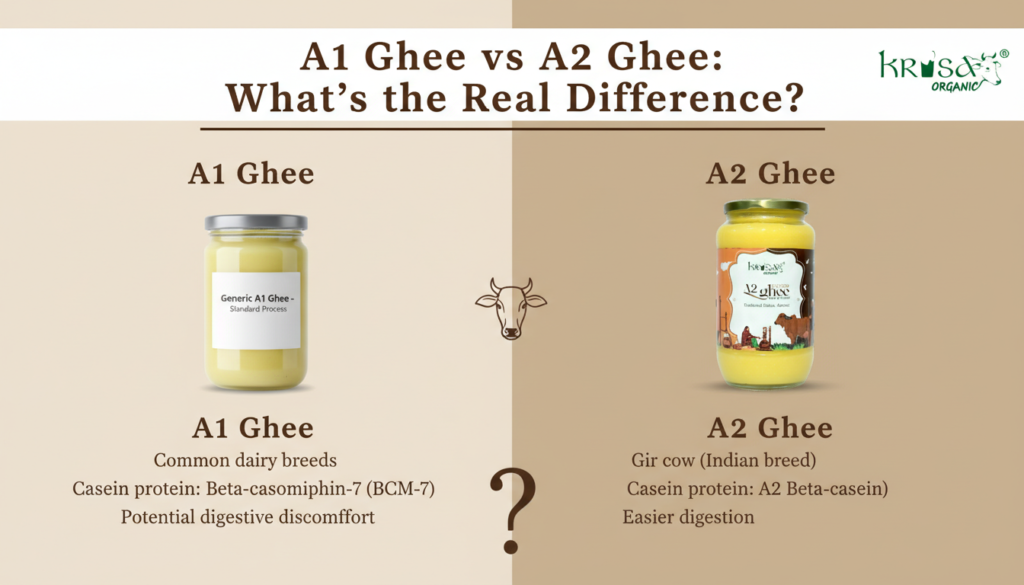
Ghee has been a cherished part of Indian kitchens and traditional medicine for thousands of years. Lately, you may have come across two labels on ghee jars A1 Ghee and A2 Ghee and wondered what sets them apart. While both types come from cow’s milk, they differ in the kind of protein they contain, how easy they are to digest, and their overall health impact.
In this blog, we’ll begin with a clear, side-by-side comparison table that highlights the key features of A1 and A2 Ghee—right from their source breeds to taste, color, and Ayurvedic value. After the table, we’ll dive deeper into what these differences mean for your digestion, immunity, heart health, and more. We’ll also share simple tips on how to spot genuine A2 Ghee in the market and explain why many health experts and families are choosing it over standard A1 Ghee.
Whether you’re new to the world of ghee or just curious about the A1 vs A2 debate, this introduction will set the stage for an easy-to-follow, trustworthy guide. Let’s get started—with a quick glance at the table below—to see which ghee might be the best fit for your kitchen and well-being.
✅ A1 Ghee vs A2 Ghee: Everything You Need to Know
Here’s a table showing the main differences between A1 and A2 Ghee:
| Feature | A1 Ghee | A2 Ghee |
|---|---|---|
| Source of Milk | Hybrid or foreign cow breeds (e.g., Holstein, Jersey) | Indian desi cow breeds (e.g., Gir, Sahiwal, Rathi) |
| Protein Type | Contains A1 beta-casein protein | Contains A2 beta-casein protein |
| Digestibility | Can cause discomfort in some people | Easily digestible |
| Lactose & Casein | Trace amounts may remain | Almost negligible |
| Taste | Slightly creamy or neutral | Rich, nutty, aromatic |
| Color | Pale yellow to white | Golden yellow |
| Price | Less expensive | More expensive |
| Availability | Widely available in markets | Limited supply |
| Health Benefits | Standard nutrition | Rich in Omega-3, CLA, Vitamins A, D, E |
| Production Quantity | High yield from foreign cows | Lower yield from desi cows |
| Suitable For Children | May cause issues in sensitive children | Ideal for babies and children |
| Ayurvedic Value | Not mentioned in Ayurveda | Highly recommended in Ayurveda |
| Ethical Farming | Mostly commercial farms | Often sourced from ethical gaushalas |
What Is the Real Scientific Difference Between A1 and A2?
The key difference between A1 and A2 ghee is that the type of beta-casein protein, which is found in the milk used to produce ghee, is different in A1 and A2 ghee. Although ghee contains very little protein compared to milk, the source of milk is an important factor in determining the digestibility and health benefits associated with it.
Milk from A1 cows contains A1 beta-casein, which, when digested, can release a peptide called BCM-7 (Beta-Casomorphin-7). Some studies have found that BCM-7 can cause digestive problems in some people. In contrast, milk from indigenous Indian cows contains A2 beta-casein, which does not break down BCM-7.
Although ghee is clarified and contains very little milk solids, the source of milk and the traditional fermentation process involved in A2 bilona ghee may increase its digestibility and health benefits. This is why many health-conscious people choose to buy A2 ghee.
Is A2 Ghee Healthier Than A1 Ghee?
The response to this question depends on individual sensitivity, quality of preparation, and sourcing. A2 ghee is also linked to traditional Ayurvedic preparation techniques, particularly the bilona process, which involves the churning of curd to obtain butter.
This process can assist in preserving the following:
Natural aroma
Nutritional integrity
Improved digestibility
On the other hand, commercially available A1 ghee is prepared from cream.
Although both sources of ghee are rich in healthy fats and fat-soluble vitamins, many people have reported feeling lighter and having improved digestion with A2 ghee.
Why Is A2 Ghee More Expensive?
The A2 ghee tends to be more expensive due to the following reasons:
The indigenous cow produces less milk than the crossbreed cow.
The bilona method of preparation is more labour intensive.
The production is done in smaller batches.
The grass-fed desi cow requires special care.
Higher cost often reflects sourcing quality and traditional processing rather than just branding.
Frequently Asked Questions
Is A2 ghee really better than A1 ghee?
Many people prefer A2 ghee due to easier digestibility and traditional sourcing, though both contain similar calorie content.
Can A1 ghee cause bloating?
Some individuals sensitive to A1 protein may experience digestive discomfort.
Does A2 ghee contain lactose?
Properly prepared ghee contains negligible lactose.
Which ghee is best for daily use?
High-quality, traditionally prepared ghee from reliable sources is ideal for daily use.
Is A2 ghee good for heart health?
Moderate consumption within a balanced diet is key for any type of ghee.
Where To Buy A2 desi Ghee?
If you’re investing in your family’s health, the source of your ghee matters. Traditionally prepared A2 Desi Cow Ghee made using the bilona method preserves natural aroma, nutrients, and authenticity that modern processing often compromises.
Experience the richness of pure, farm-sourced A2 ghee crafted with care and transparency.
👉 Shop Authentic A2 Desi Cow Ghee Now- https://www.krisafarm.com/shop/